
The federal rules committee has been debating disclosure for over a decade. The harder question is what information courts actually need, and who should see it.
A familiar debate, with new evidence
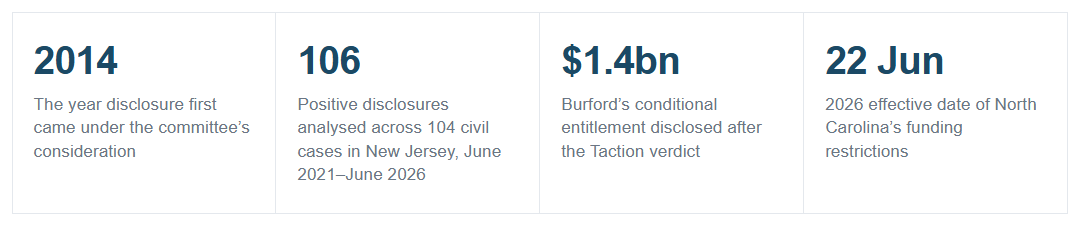
At its 21 October 2026 meeting, the Advisory Committee on Civil Rules again left open whether to recommend a nationwide rule requiring disclosure of third-party litigation funding. The issue has been under consideration since 2014. The options on the table include amendments to Rule 26, or provisions attached to case management or party disclosures under Rules 16 and 7.1.
The committee has more evidence than a year ago, if not more certainty. An October report from the Federal Judicial Center examined five years of disclosure under the District of New Jersey’s local rule and analysed 106 positive disclosures across 104 civil cases. Of the 106 disclosures, 69 were identical filings in related cases. While that is a useful picture of reported funding in one district, it is not a measure of the national funding market, still less of undisclosed arrangements.
A patchwork of local rules and state statutes
Individual courts have gone their own way. Standing orders in Delaware patent litigation prompted scrutiny of funder identity and control; New Jersey has a district-wide disclosure rule; elsewhere, obligations arise from local rules, case-specific orders or ordinary discovery disputes.
State legislatures are also moving. North Carolina’s Prohibit Litigation Investments Act, effective from 22 June 2026 for the proceedings and agreements it specifies, restricts outcome-contingent litigation investment in the state, subject to statutory exceptions. At federal level, the proposed Litigation Funding Transparency Act of 2026 would require funding disclosures in specified class actions, multidistrict litigation and large coordinated proceedings. It is a bill, not law, and it does not generally reach ordinary single-plaintiff patent cases.
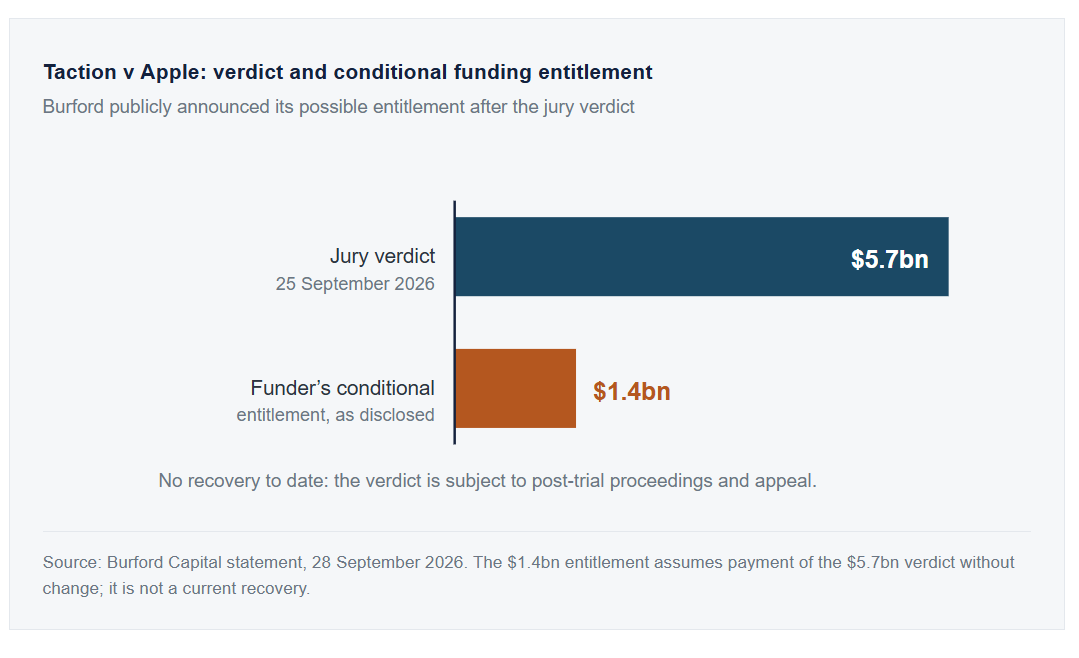
The recent $5.7 billion jury verdict in Taction Technology v Apple illustrates the potential scale of funded patent claims. Following the verdict, Burford publicly stated that it would be entitled to $1.4 billion if the verdict were paid unchanged. Neither figure represents a recovery, and Burford’s statement should not be confused with a court order requiring production of a funding agreement.
Where the line should sit
There are legitimate reasons for a court to know whether a claim is funded and, in some circumstances, who stands behind it: conflicts, control, security for costs and the integrity of proceedings can all be relevant. It does not follow that defendants should receive the economics of the agreement, or the claimant’s budget and certainly not the assessment of its own litigation risk.
Nor can an entire funding agreement automatically be treated as privileged work product. Protection depends on the document’s contents, the circumstances in which it was created and the applicable law; terms may be discoverable in some courts and protected in others. These are questions for targeted, case-specific analysis, not blanket assertion in either direction.
For Erso, we maintain that the sensible approach is to build arrangements that can withstand judicial scrutiny while preserving the claimant’s decision-making autonomy and genuinely confidential commercial information. Claimants and their lawyers should know the rules of their chosen forum before signing, expect requests for disclosure, and document who controls litigation and settlement decisions.

Until the federal position becomes clearer, parties need funding structures that are robust enough to withstand proper scrutiny without surrendering commercially sensitive case strategy.
Sources: MLex, reporting the Advisory Committee on Civil Rules meeting of 21 October 2026; Federal Judicial Center, Third-Party Funding Disclosures in the District of New Jersey, June 2021–June 2026 (published 20 October 2026; 106 disclosures in 104 cases); North Carolina Session Law 2026-14 (Prohibit Litigation Investments Act); S.3826, the proposed Litigation Funding Transparency Act of 2026; Burford Capital statement regarding the jury verdict in Taction Technology v Apple, 28 September 2026. This piece reflects general market observations and is not legal or investment advice.KEY CONTACTS

James Blick, Director and Co-founder (USA)
+1 (877) 766 8958

Bob Knock, Investment Counsel (UK)