
How AI Will Change the Economics of Litigation Finance
James Delaney, Founder & Director · 8 min readMost discussion of AI in the legal sector asks what it means for law firms. For litigation finance, the more important question is what it does to the economics of disputes themselves: what a claim costs to pursue, how long it takes, and therefore which claims can support external funding.
Mainstream use of generative AI is less than four years old, and the tools are improving faster than the profession has adjusted to them. Even on today's capabilities, the funding equation is shifting. The pace of improvement suggests today's position is much closer to the starting point than the destination. The question is no longer whether AI changes litigation economics, but how quickly, and who ultimately captures the savings.
The cost of pursuing a claim
Research, document review, evidence analysis, chronology building and first drafts can already be completed in a fraction of the time previously required. As adoption spreads, fewer professional hours should mean a smaller budget for the same case, pursued to the same standard.
That matters because one of the central considerations in any funding assessment is the relationship between the budget and the realistic recovery. Many funders look for damages in the region of eight to ten times the budget through trial, although thresholds vary by case, funder and structure. Strong claims regularly fail that test, particularly below the very largest commercial disputes.
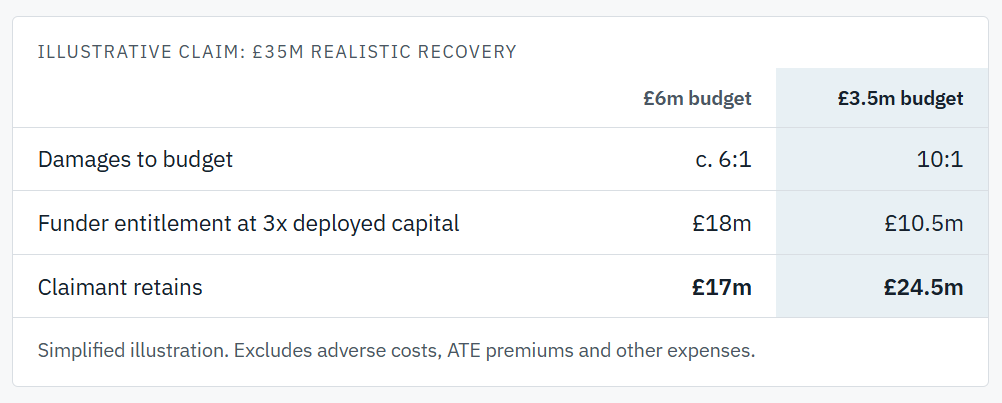
Take a claim with a realistic recovery of £35 million and a budget of £6 million through trial, with the funder's entitlement calculated at three times deployed capital. On a simplified basis, ignoring other costs:
Make it stand out
Nothing about the merits has changed. But a claim that sat below many funders' preferred threshold now meets it, the capital requirement has fallen by £2.5 million, and the claimant retains £7.5 million more of the recovery.
Part of the rationale for these thresholds is to provide sufficient headroom if damages are ultimately lower than expected, without the funder's return becoming an impediment to a commercially sensible settlement.
Duration
The less discussed effect, and for funders potentially the more important one, is time.
Some elements of a case's timetable will not compress quickly. Trial listing, judicial availability and courtroom capacity are resourcing constraints rather than questions of efficiency, and experts, witnesses and procedural strategy will continue to set the pace of many cases. Courts will continue to adopt technology in case management and administration, and the senior judiciary has already issued guidance on the use of AI. But the work between procedural stages should shorten well before the wait for a trial date does.
Much of a dispute's life is spent between those stages. One side undertakes an exercise, the other reviews it, advice is taken, evidence is analysed, and submissions and responses are drafted. Each step can take weeks or months. As claimant and defendant teams increasingly complete that work in a fraction of the time, those savings should begin to accumulate throughout the life of a complex case.
AI will not turn every five-year dispute into a three-year one, but even a modest compression in average duration matters considerably to a funder.
Why duration matters to a funder
Capital committed to a case cannot generally be redeployed until it resolves. Duration therefore drives internal rates of return, portfolio construction and capital recycling.
A 3x return achieved over three years equates to an annualised return of roughly 44%. The same multiple achieved over six years is approximately 20%, assuming for simplicity that all capital is deployed at the outset. The case is identical; the investment is not. Shorter expected durations can bring marginal cases within a funder's investment criteria and return capital for redeployment sooner.
The claimant benefits twice
Many funding agreements link the funder's return to time, either directly or through stepped multiples, so faster resolution can reduce the cost of funding. The claimant needs less capital because the underlying legal budget is smaller, and that capital remains deployed for a shorter period. The result is two distinct savings: lower legal expenditure and lower funding costs.
Adverse costs and security
The effect extends beyond the claimant's own spend. If AI reduces the professional time required on the defendant side, the claimant's potential adverse costs exposure should also begin to reduce, and so may the amount of ATE cover required.
Security for costs remains a matter for the court, and ATE pricing reflects more than the defendant's budget, so the link is not automatic. But if the cost base on both sides falls materially, this component of the claimant's exposure should move in the same direction.
The objections
There is no certainty about the future, and some will argue the above is too simplistic. Three objections deserve a direct answer.
Firms will resist. Firms billing by the hour have little immediate incentive to pass every efficiency through, and many will not volunteer it. But the pressure increasingly comes from the client side. General counsel using AI internally will have a clearer understanding of what particular exercises should cost and will challenge external spend accordingly. Funders will scrutinise budgets in the same way and push towards caps, fixed fees and other arrangements that share efficiency gains. Over time, that pressure may also accelerate the move towards fixed, capped and value-based fee structures, giving claimants and funders greater certainty over the ultimate cost of pursuing a case. Resistance may slow the pass-through of savings, but it is unlikely to prevent it.
Defendants have the same tools. Cheaper production can mean more documents, more applications and more satellite disputes. In some cases that will happen. But defendants face the same cost pressures from their boards, insurers and clients, and material generated cheaply can be reviewed cheaply as well.
Funders earn less on smaller budgets. Where returns are calculated as a multiple of capital, a smaller commitment produces fewer pounds of return on an individual investment. But AI should also reduce the funder's own cost of assessing claims. Underwriting effort has historically created a minimum economic case size, because a £2 million claim can require many of the same diligence exercises as a £20 million claim. As the cost and time of assessment fall, the viable threshold moves from both directions.
A larger pool of fundable cases should also increase competition between funders, placing its own pressure on the price of capital to the benefit of claimants.
A wider market
Funding has worked most comfortably where damages are large enough to absorb the cost of litigation, the funder's return and an attractive residual recovery for the claimant. Lower budgets and shorter durations move that threshold down.
Cost and time are not the only deterrents. The burden of a dispute on management time and attention prevents some perfectly viable claims from being pursued at all. As disputes become less arduous to manage, more claimants may be prepared to bring them. Funders, meanwhile, may be able to deploy smaller amounts across a larger number of cases, improving diversification and recycling capital more quickly.
Where the value moves
The deeper change is not simply that legal work becomes faster. It is that analytical capacity, the ability to process information, identify issues and produce reasoned output, is becoming cheaper and more widely available. For generations, a significant part of professional value has rested on scarce intellectual labour. AI is reducing that scarcity.
That does not make experienced litigators less valuable. It may, however, change the traditional pyramid beneath them. A complex matter that might previously have required two senior associates and a larger team of associates and junior lawyers may increasingly be run by a much smaller team, supported by AI tools undertaking a significant proportion of the underlying analysis, review and first-stage drafting.
The value of the experienced litigator therefore remains, and may even become more pronounced. What changes is the amount of professional resource required around that individual to deliver the same result.
As analytical work becomes easier to produce, the premium attaches to what cannot readily be delegated: judgement about how a tribunal will receive an argument, strategy under uncertainty, advocacy, negotiation and responsibility for the advice ultimately given. These depend on experience, accountability and professional duty as much as analytical horsepower, and they remain fundamentally human.
For funders the distinction matters. Fewer hours does not mean less value. The firms best placed will be those that deliver senior judgement efficiently, with technology supporting that judgement rather than adding another layer of cost around it.
Conclusion
There will be resistance, and some constraints, such as trial listing, will move slowly. But the direction of travel appears clear. We believe the economics of complex disputes will look markedly different over the next decade.
The most significant consequence for litigation finance may not be that existing cases become cheaper to fund, but that a wider category of claims becomes fundable in the first place.
This article is for general information only and does not constitute legal, financial or investment advice. Figures are illustrative.