
Filings at a ten-year high, the PTAB in retreat: what the 2026 data says about funding US patent claims
The latest data from Lex Machina captures more about the current US patent funding market than any amount of commentary. Its 2026 Patent Litigation Report covers 38,893 district court cases filed between 2016 and 2025, together with PTAB petitions, appeals and observations from the first half of 2026.
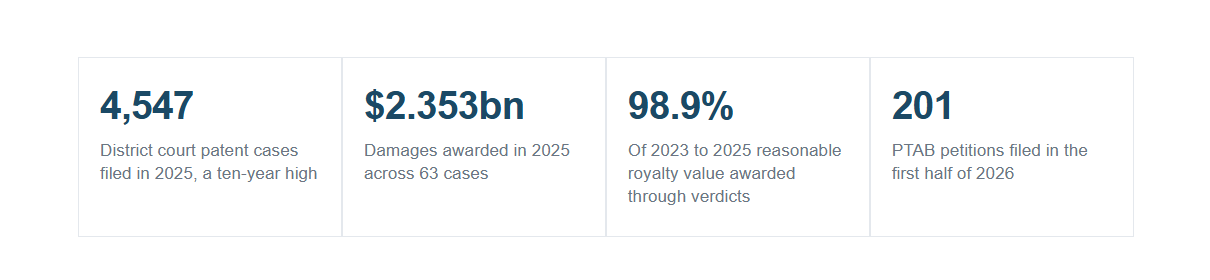
Three findings stand out to the team at Erso.
Volume
The first is volume. Plaintiffs filed 4,547 patent cases in 2025, a 19.6% increase on 2024 and the highest total in the report’s ten-year period. The first half of 2026 then slowed, with approximately 1,900 new suits filed between January and June. That puts this year on course to finish comfortably below the 2025 record.
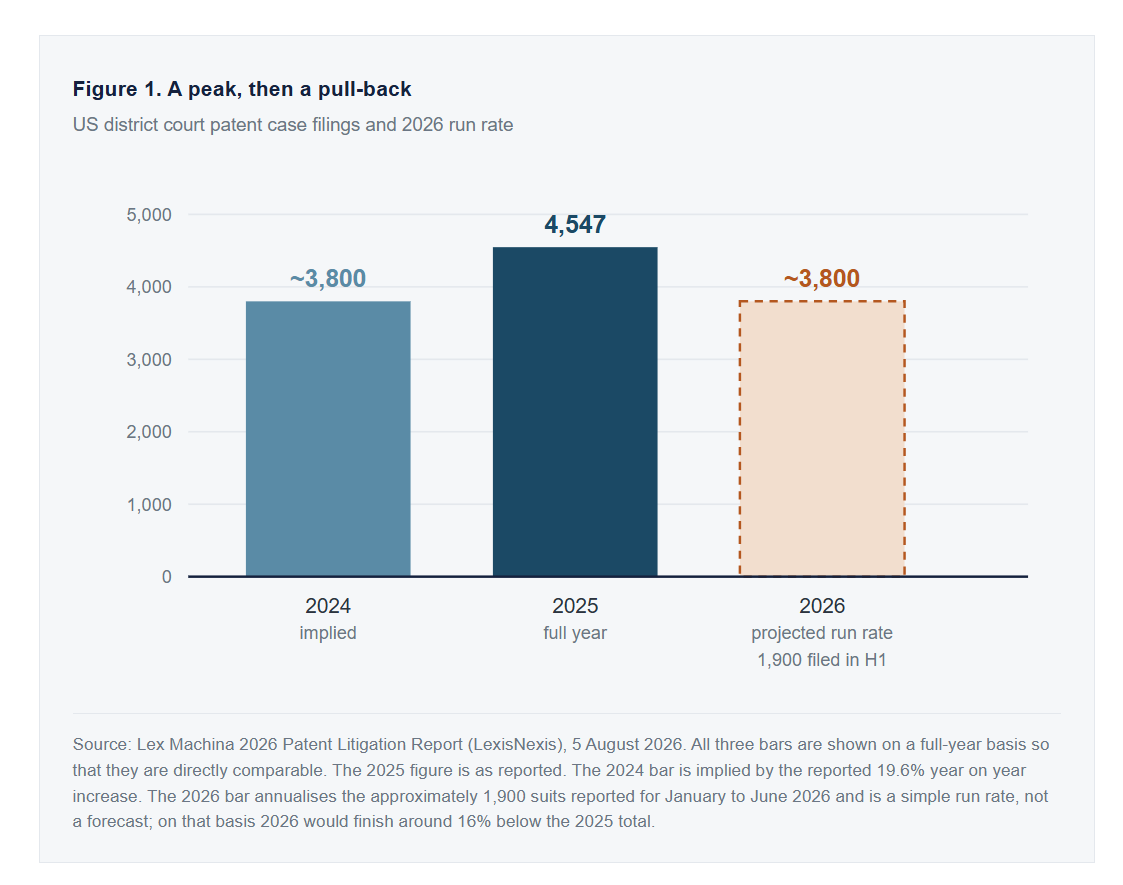
The picture is therefore a peak followed by a pull-back, not a collapse. Importantly, Lex Machina reports that the 2025 growth extended beyond high-volume plaintiff campaigns. For a funder, that suggests a broader opportunity set rather than an increase driven solely by a small number of repeat filers. Whether that produces more genuinely fundable claims will depend on their quality, ownership and economics, but the underlying market is active.
Quantum
The second finding is quantum. Courts awarded $2.353 billion in patent damages across 63 cases in 2025, excluding fees and interest. Annual damages have now remained above $2 billion for four consecutive years.
From 2023 to 2025, reasonable royalty awards totalled $8.156 billion, of which $8.066 billion came through verdicts. The concentration is striking. The highest-value recoveries continue to depend heavily on cases capable of surviving through trial, rather than being resolved through early procedural outcomes.
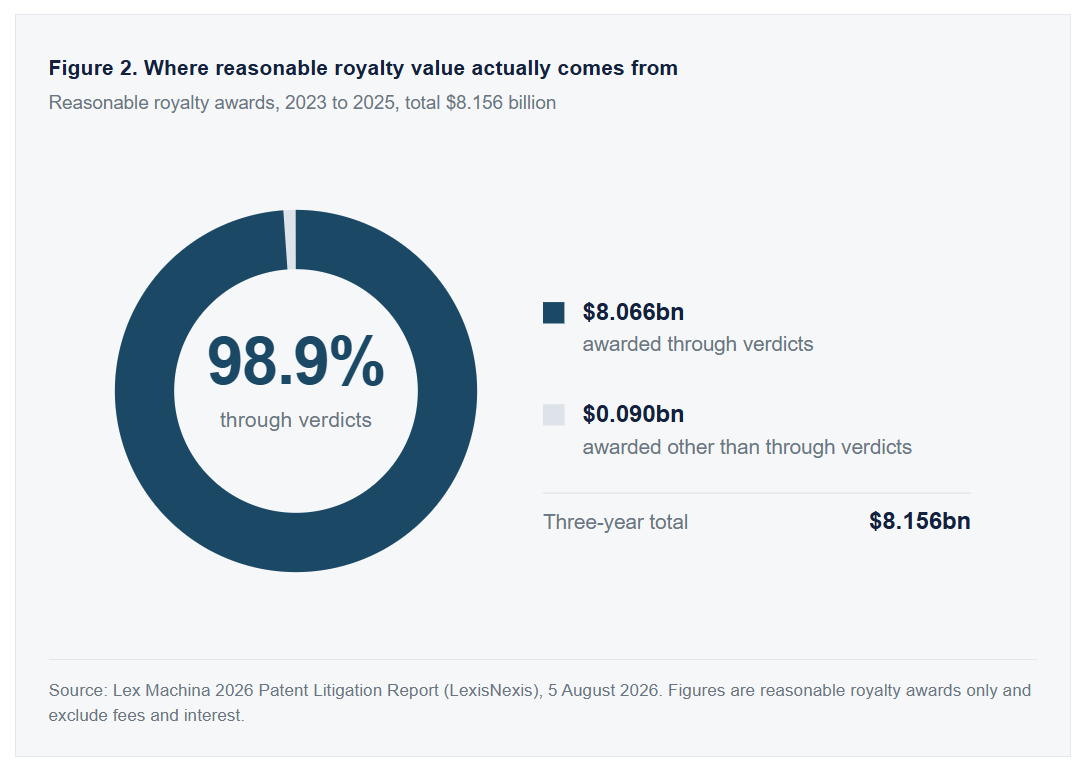
For a funder, that reinforces the importance of underwriting the entire litigation path. A credible settlement case matters, but it cannot substitute for a trial-ready patent, damages case and legal team. The strongest settlement leverage usually comes from demonstrating that the claimant can take the case through verdict and beyond.
The PTAB in retreat
The third finding is the sharp decline in PTAB activity. Inter partes review petitions fell by approximately 8% to 1,208 in 2025. In the first half of 2026, parties filed only 201 PTAB petitions in total, fewer than in any other half-year period for at least a decade. Post-grant review petitions moved in the opposite direction during 2025, rising to 75, their highest level since 2021, although from a much smaller base.
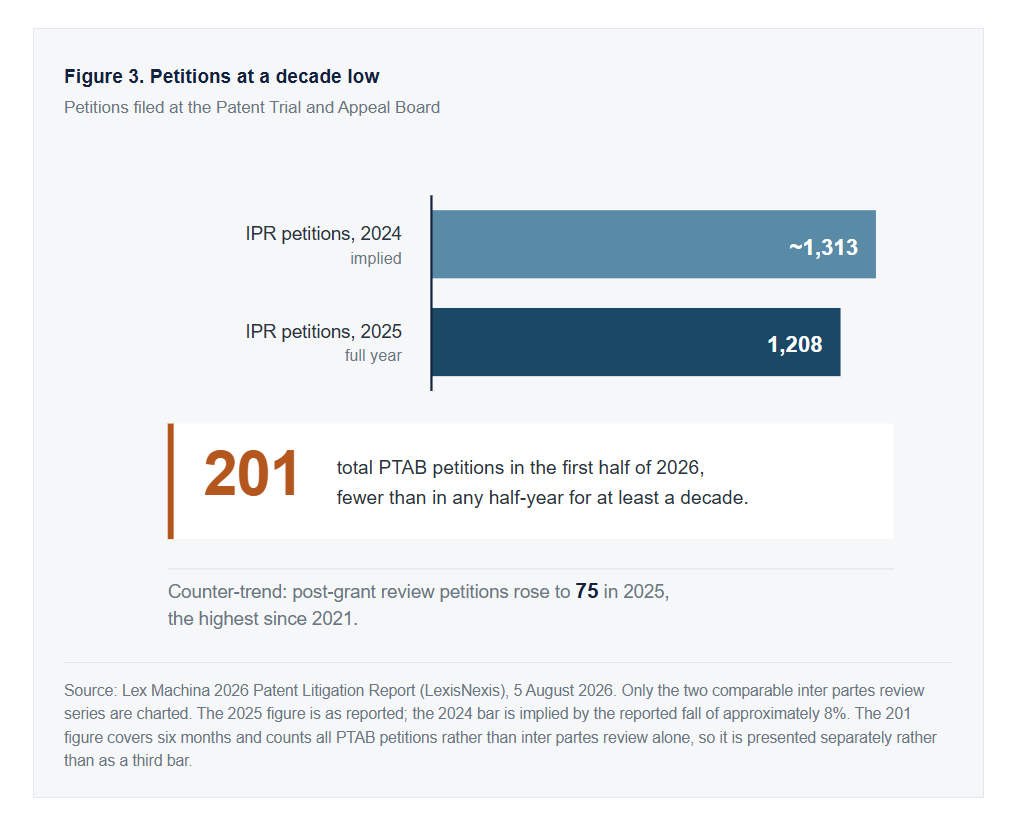
For much of the past decade, a funded patentee had to assume that a well-resourced defendant would open a second front before the Patent Office. The budget, timetable and expected recovery all had to reflect the likelihood of an IPR petition and the possibility that the district court proceedings would be stayed.
That assumption is now weaker. It has not disappeared.
Defendants retain district court invalidity defences and may pursue other Patent Office routes, including ex parte re-examination. PTAB filing levels may also change again as policy and institution practice develop. Nevertheless, the immediate risk of a parallel inter partes review appears materially lower than it was.
That can produce a cleaner route through the district court, but it is not an unqualified positive. Where validity remains in the district court case, the claimant must be prepared to litigate it as part of the wider infringement action. The dispute becomes more concentrated, with validity, infringement and damages carrying greater combined significance.
For a funder, that raises the importance of technical diligence before capital is committed. Claims that might previously have faced an early institution decision still need to be tested. If that screening does not occur at the PTAB, it must occur during underwriting.
What this means for underwriting
Our view of the US patent market is therefore more constructive than it was two years ago, but not less selective.
The 2025 filing peak and sustained damages levels point to a larger opportunity set. Reduced PTAB activity may also lower the cost and disruption created by parallel proceedings. Neither development turns a weak claim into an investable one, and neither removes the volatility inherent in patent litigation.
The concentration of reasonable royalty awards in verdicts also means that trial and appellate risk remain central. A damages award is not the same as a cash recovery. Post-trial motions, Federal Circuit scrutiny, collection risk, duration and the cost of continued enforcement all need to be reflected in the funding model.
For patent litigators and claimants, the practical conclusion is that capital is available for strong cases, particularly where the claimant can present a coherent plan through trial and appeal. The headline damages figure may begin the conversation, but it will not determine the investment decision.
At Erso, what matters is the quality of the patent, the infringement evidence, the defensibility of the damages analysis, the trial team and a realistic assessment of the appellate path. The latest data makes the market look more attractive. It does not make the underwriting any easier.
All figures are drawn from the Lex Machina 2026 Patent Litigation Report, published by LexisNexis on 5 August 2026, which covers 38,893 district court patent cases filed between 2016 and 2025 together with PTAB petitions and appeals and observations from the first half of 2026. Figures described as implied are derived from percentage changes reported in that publication and are shown for context only. This piece reflects general market observations and is not legal or investment advice.KEY CONTACTS

James Blick, Director
(USA)
+1 (877) 766 8958

Bob Knock, Investment Counsel
(UK)
(+44) 0203882 7454