
IPRs down, ex parte re-examinations up: does the shift favour patent funders?
Our review of the latest US patent litigation data identifies the sharp decline in PTAB activity as one of the year’s most important developments. The headline numbers are encouraging, but they do not tell the whole story. IPR petitions have fallen dramatically while requests for ex parte re-examination have reached record levels. For patent funders, the question is not simply whether Patent Office activity has declined, but how the change affects duration, deployment and risk.
Only 201 PTAB petitions were filed during the first half of 2026, comprising 174 inter partes review petitions and 27 post-grant review petitions. That was a 72.5% reduction from the 732 PTAB petitions filed during the same period in 2025.
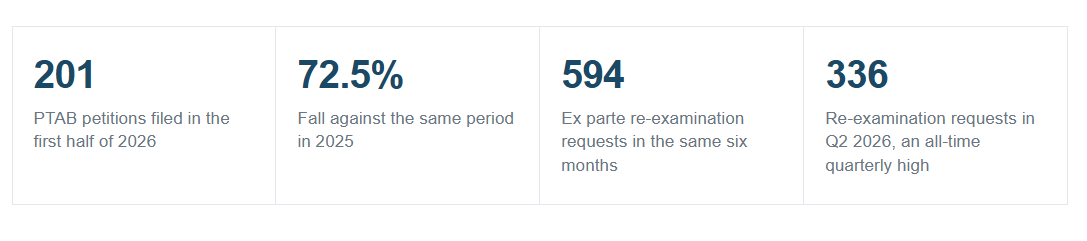
IPR petitions fell to an all-time quarterly low of 57 in the second quarter of 2026. Post-grant review has provided a limited counter-trend, with 75 petitions filed in 2025, the highest annual total since 2021, but it remains a much smaller category.
For patent owners, the decline in IPR activity appears positive. For funders, the position is more nuanced, although we also see the overall direction as encouraging.
For much of the past decade, a claimant bringing a serious patent case had to assume that the defendant would open a second front before the Patent Office. An IPR could proceed alongside the district court claim or provide the basis for a stay. Either way, it introduced another adversarial process, another budget and another source of uncertainty before the claimant could reach a decision on infringement and damages.
Fewer IPRs reduce that particular risk. A patent case without a parallel IPR may follow a cleaner route through the district court. There may be less duplication, less uncertainty over whether the court will stay the action and a more direct timetable towards trial and a damages determination.
For a funder, that matters.
Litigation risk and duration risk
Litigation risk and duration risk are separate parts of an investment decision. Litigation risk concerns whether the claim will ultimately succeed. Duration risk concerns how long the funder’s capital will remain deployed before that outcome is reached.
The distinction is important because the same recovery has a different economic value depending on when it is received. A case that returns capital in three years is not the same investment as one producing the identical recovery after six. Our funding structures will therefore often include some form of duration-based escalation. This reflects both the time value of the capital and the opportunity cost of being unable to deploy it elsewhere.
A parallel IPR can make that duration materially harder to predict. The possibility of institution, a district court stay and any subsequent appeal creates several potential timetables. Removing one of those procedural tracks does not make the patent stronger, but it may make the likely duration of the investment easier to assess and price.
The second front has changed rather than disappeared
There is, however, an important qualification. The second front has changed rather than disappeared.
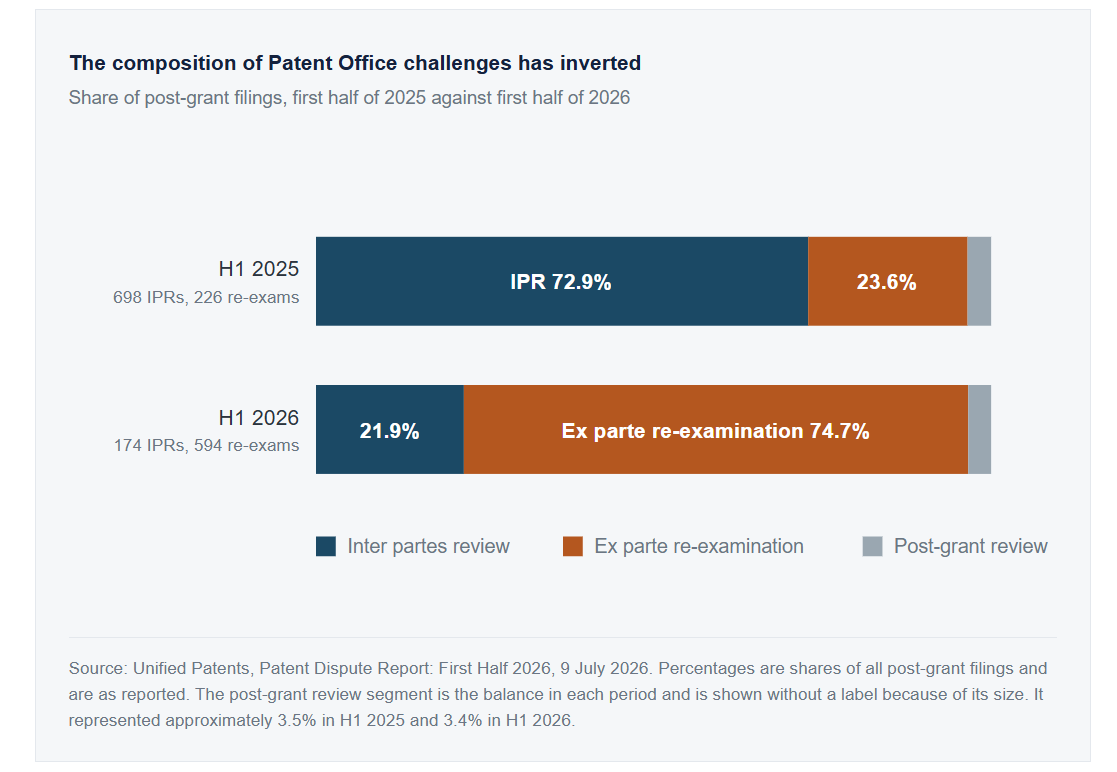
Unified Patents recorded 594 requests for ex parte re-examination during the first half of 2026, including a record 336 in the second quarter. Ex parte re-examinations represented 74.7% of post-grant filings during the six-month period, compared with 23.6% a year earlier. Over the same period, the proportion represented by IPRs fell from 72.9% to 21.9%.
The activity has not been driven solely by specialist challengers. Large operating companies were among the most active requesters, including Samsung, Apple, Cisco, Intel and Google. The defendants that previously made extensive use of IPRs have not abandoned Patent Office challenges. Many are using a different route.
An ex parte re-examination is a different kind of second front. After the initial stages, the requester does not remain an active party in the same way as an IPR petitioner, and there is no equivalent inter partes estoppel. That can reduce the cost and intensity of the parallel process.
It does not eliminate disruption. A pending re-examination may still support an application to stay the district court proceedings, with the result depending on the court, the stage of the litigation and the effect the re-examination may have on the issues. Re-examination also lacks the same statutory timetable as an IPR and can affect claim scope as well as validity. From a funding perspective, it may be less procedurally intensive, but it is not necessarily quicker or more predictable.
The migration towards ex parte re-examination qualifies the positive story, but does not reverse it.
The sharp decline in IPRs reduces the frequency of a costly adversarial process that has complicated the route to trial and damages. The replacement risk must be modelled differently rather than ignored.
When the answer on validity arrives
There is a further trade-off. An IPR can provide a relatively early answer on validity. If the patent does not survive, the result is adverse for both claimant and funder, but it may arrive before the full district court budget has been deployed.
Where validity is instead resolved later in the district court proceedings, a claimant may incur substantial expenditure on discovery, experts, claim construction and damages before receiving that answer. If the patent then fails, the funder may have deployed most or all of its commitment before the adverse result arrives.
The decline in IPRs can consequently reduce the cost and uncertainty associated with one form of parallel proceeding while increasing the proportion of capital exposed to a later validity decision.
Underwriting and budget phasing
That reinforces the importance of rigorous underwriting and disciplined budget planning.
We have always stress-tested validity before committing capital. That includes analysing the prior art, prosecution history, claim construction and the arguments likely to be advanced by the defendant. The change in post-grant strategy does not alter that approach or the standard a claim must meet.
What it changes is the likely deployment profile. If validity is determined later, or an ex parte re-examination affects the district court timetable, a greater proportion of the committed capital may be exposed for longer.
That makes it particularly important to work with the legal team at the outset to agree sensible budget phasing. A district court budget should identify when expenditure is genuinely required, the assumptions supporting each phase and the points at which the case, budget and strategy should be reassessed.
Good budget phasing does not mean delaying work that is necessary to run the claim properly. Nor does it mean approaching the case on the assumption that it will fail. It means maintaining discipline over when capital is deployed and ensuring that expenditure remains proportionate to the information available at each stage.
Our position
Against that background, we regard the decline in IPR activity as positive overall. It strengthens our view that patent disputes will remain an increasingly important part of Erso’s portfolio, and we expect to increase our volume of participation in the market while remaining selective about the claims we support.
The headline PTAB figures do not mean that Patent Office challenges are disappearing. The rapid growth of ex parte re-examination must now be reflected in validity diligence, duration assumptions and budget phasing.
What is changing is the nature of the second front. For a funder, that creates new considerations, but it may still provide a less fragmented route to a decision than the IPR environment of recent years.
The path is not necessarily safer. On balance, however, we believe it is becoming more investable.
Sources: Unified Patents, Patent Dispute Report: First Half 2026, published 9 July 2026, for post-grant composition, re-examination volumes and requester rankings; Lex Machina 2026 Patent Litigation Report, published by LexisNexis on 5 August 2026, for the 2025 PGR total and the 201 PTAB petitions filed in the first half of 2026. District court filing and damages figures are discussed in the companion piece linked above. This piece reflects general market observations and is not legal or investment advice.KEY CONTACTS

James Blick, Director (USA)

Bob Knock, Investment Counsel (UK)